5 Signs Your Website Is Losing Customers
Your website should be one of your business’s hardest-working assets. It should build trust, clearly explain what you offer, answer potential customers’ questions, and make it easy for them to take the next step.
But what happens when your website isn’t converting visitors into customers, and could actually be causing potential customers to choose your competitors instead?
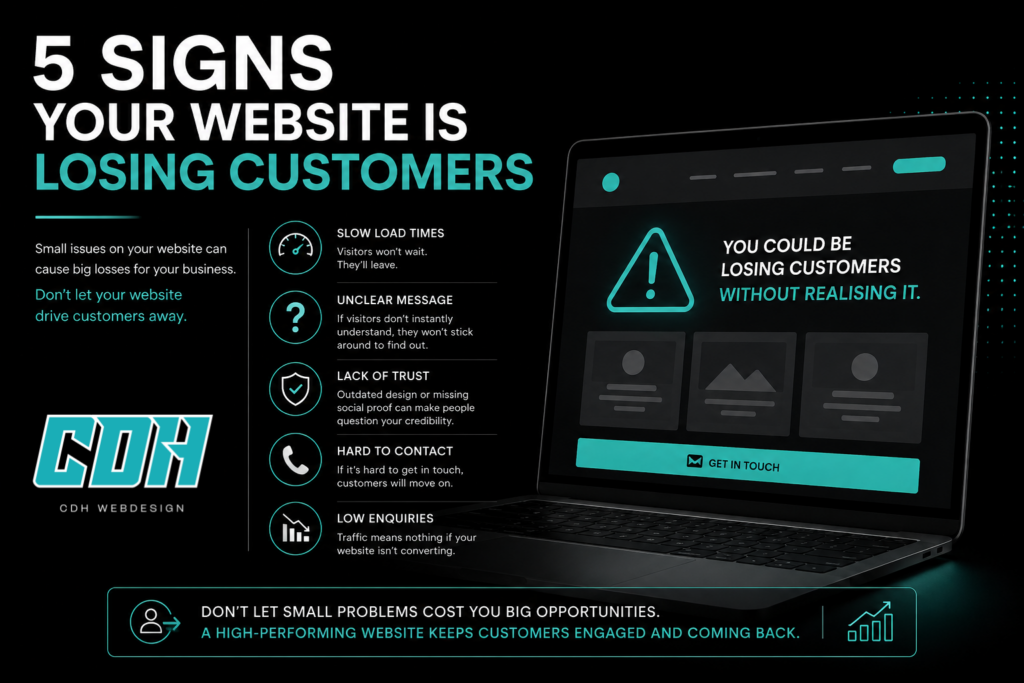
The problem is that most businesses never see the customers they lose. A potential customer visits your website, struggles to find what they need, becomes uncertain about your business, and leaves. There is no notification telling you why they left. No message saying, “Your website was too slow,” or “I couldn’t find your contact details.”
They simply disappear.
If your website isn’t generating as many enquiries, calls, or sales as you think it should, these five warning signs could be the reason.
Your Website Takes Too Long to Load
One of the biggest signs your website is losing customers is painfully slow loading times.
People are impatient online. If your website takes several seconds to load, visitors may leave before they’ve even seen what your business offers.
This is especially important on mobile devices, where people may be browsing on slower connections or using their phones while they’re out and about.
A slow website doesn’t just create a poor user experience. It can also negatively affect your search engine rankings, making it harder for potential customers to find your business through Google.
Large images, unnecessary animations, outdated plugins, excessive scripts, and poor website hosting can all contribute to slow performance.
Your website doesn’t need to be packed with flashy features. It needs to be fast, responsive, and easy to use.
Ask yourself: If someone discovered your business through Google today, would your website load quickly enough to keep them interested?
If the answer is no, you’re potentially losing customers before they ever have a chance to contact you.
Visitors Can’t Immediately Understand What You Do
When someone lands on your website, they shouldn’t have to figure out what your business does.
Within a few seconds, visitors should understand:
What your business does
Who you help
What services you provide
Why they should choose you
What they should do next
Unfortunately, many business websites make this unnecessarily difficult.
The homepage might contain a vague headline such as “Building Better Futures” or “Quality Solutions. Exceptional Results.” While these statements might sound professional, they don’t necessarily tell a potential customer what you actually do.
Your website copy should communicate your value clearly.
For example, instead of a generic headline, a commercial plumbing company could say:
“Commercial Plumbing Services Across Brisbane”
The visitor immediately knows what the company does and where it operates.
Clear messaging is particularly important for businesses competing in crowded industries. If a potential customer has to spend time searching through your website to understand your services, they may simply move on to a competitor.
Good web design isn’t just about making a website look attractive. It’s about communicating the right information quickly.
Your Website Doesn’t Look Trustworthy
Before contacting your business, potential customers are often asking themselves one simple question:
“Can I trust this company?”
Your website plays a huge role in answering that question.
An outdated design, blurry images, broken links, inconsistent branding, poor-quality content, or an obviously old website can make visitors question whether your business is still active or professional.
This doesn’t necessarily mean your website needs to look incredibly flashy.
In fact, effective business website design is often relatively simple. What matters is that the website looks professional, functions properly, and gives visitors confidence.
You can also strengthen trust by including:
Customer testimonials
Google reviews
Case studies
Project photos
Industry certifications
Client logos
Guarantees or relevant credentials
Clear contact information
Information about your team
These elements provide evidence that your business is legitimate and capable of delivering what it promises.
Think about it from the customer’s perspective.
If they’re comparing two businesses and one has a modern, professional website filled with reviews, project examples, and clear information while the other has an outdated website with little evidence of its work, which one are they more likely to contact?
Your website may be influencing that decision without you realising it.
It’s Difficult to Contact You
This sounds obvious, but it’s surprisingly common.
A potential customer visits your website because they’re interested in your services, and then can’t figure out how to contact you.
Your contact details shouldn’t be hidden.
A strong website should make the next step obvious. Depending on your business, that might mean a prominent enquiry button, simple contact form, phone number, email address, booking system, or another straightforward way to get in touch.
Your website conversion rate depends heavily on reducing friction.
Every additional step between a customer deciding “I’d like to enquire” and actually submitting an enquiry creates another opportunity for them to give up.
Your contact page should also be easy to find from your main navigation.
Don’t make potential customers hunt for it.
And don’t ask for unnecessary information on your contact form. If you only need a name, email address, phone number, and a brief description of their enquiry, don’t create a form with fifteen fields.
Make contacting your business as easy as possible.
Your Website Gets Traffic but Generates Few Enquiries
This could be the biggest warning sign of all.
If people are visiting your website but very few are contacting you, something is going wrong between website traffic and conversion.
Getting visitors is only half the battle.
A website needs to turn those visitors into meaningful actions, whether that’s submitting an enquiry, requesting a quote, booking a consultation, calling your business, or purchasing a product.
This is where conversion rate optimisation becomes important.
Look at your website from the perspective of someone who has never heard of your business.
Does every important page have a clear call to action?
Are your services explained properly?
Are your benefits obvious?
Do you provide enough evidence to support your claims?
Are there testimonials or reviews?
Is it immediately clear how someone can get started?
If the answer to several of these questions is no, your website may be attracting potential customers without giving them enough reason or opportunity to take action.
Your Website Should Be Helping You Win Customers, Not Lose Them
Your website is often the first interaction someone has with your business.
A potential customer might discover you through Google, social media, a referral, an online directory, or a recommendation from someone they know. Before they contact you, there’s a good chance they’ll visit your website.
That’s why your website needs to do more than simply exist.
It needs to load quickly.
It needs to communicate clearly.
It needs to establish trust.
It needs to make contacting you easy.
And most importantly, it needs to turn interested visitors into enquiries.
If your website is outdated, difficult to navigate, slow, unclear, or poorly optimised, you could be losing potential customers every day without knowing it.
The good news is that these problems can usually be identified and fixed.
Your website should be an asset that helps your business grow, not a reason potential customers choose your competitor.
If you’re not sure whether your current website is helping or hurting your business, a professional website audit can reveal the biggest opportunities for improvement.
CDH WebDesign helps Australian businesses create professional, high-performing websites designed to build trust, improve visibility, and generate more enquiries.
Contact Us Now
Contact our team today and we’ll get back to you as soon as possible.